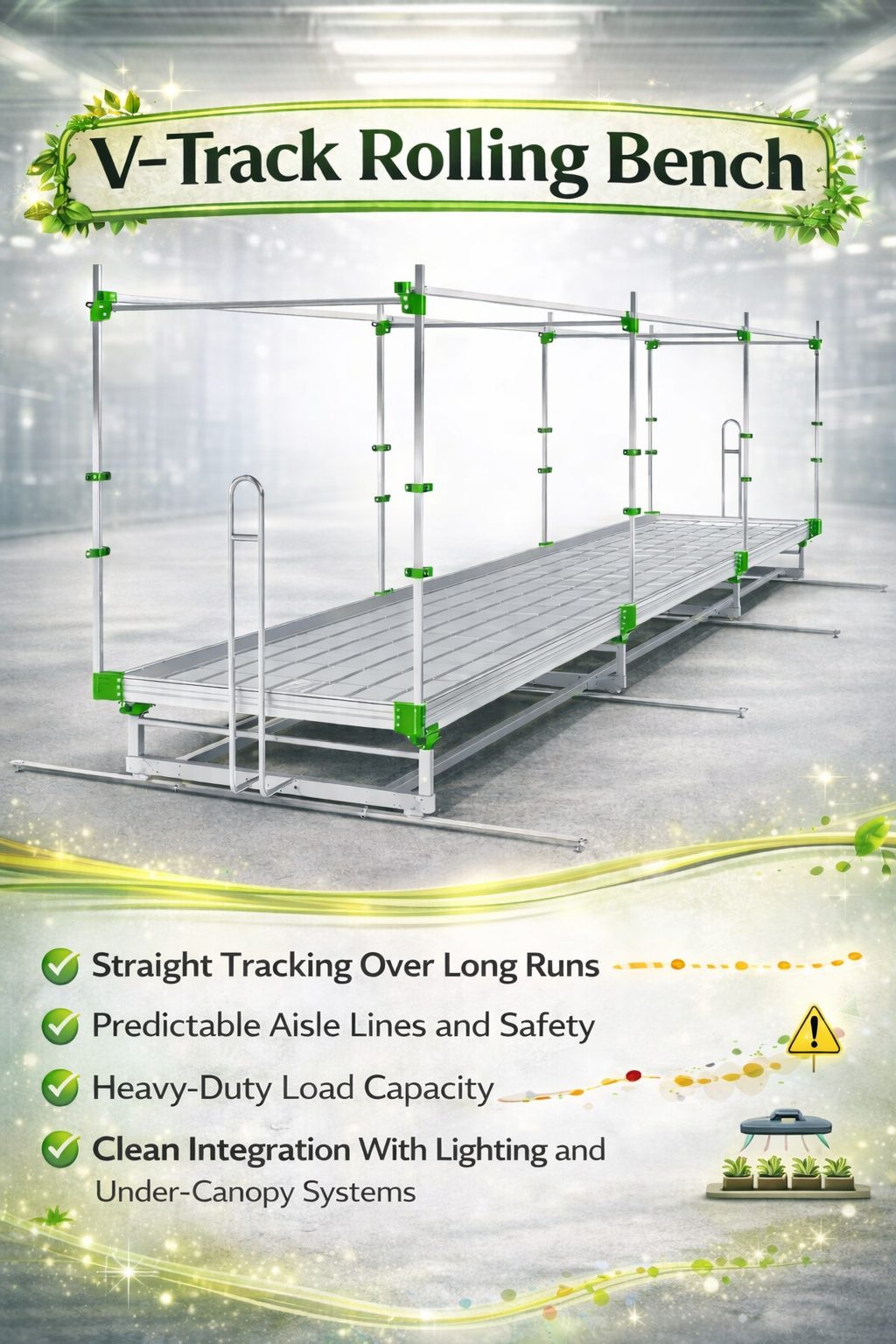
4 Critical V-Track Rolling Bench System Advantages for Grow Rooms
A v-track rolling bench system uses floor-mounted rails and guided wheels to move the entire bench side to side. Instead of just sliding the tray on a rolling bar, the whole frame rides on steel tracks set in the slab. When the bench moves, legs, frame, tray, and crop all travel together in a straight lane.
What Is a V-Track Rolling Bench System?
On a v-track bench, each run sits on a pair of V-shaped rails anchored into the concrete. Matching V-groove wheels under the base frame capture the rails so the bench can only move along that path. Staff push or crank the bench and the whole unit rolls to open or close an aisle.
Because the wheels are trapped in the tracks, the row stays aligned even when loaded with wet media and tall plants. That “locked in” feel is one reason greenhouse growers and some larger indoor rooms still choose v-track over other rolling styles.
1. Straight Tracking on Long Runs
Once benches get long, keeping them straight matters. A v-track rolling bench system forces the run to follow the rail line, so it doesn’t drift over time. In wide flower rooms or long greenhouse bays, that makes it easier to keep rows parallel and aisles where you expect them to be.
V-rails do want a reasonably flat, true slab beneath them. If the concrete is badly heaved or patched, you usually fix the floor or pour curbs and set the tracks on a corrected surface. When the rails are installed properly, though, the bench motion stays clean and predictable from end to end.
2. Predictable Aisle Lines and Safety
Because the bench can only roll along its tracks, the working aisle always opens in the same place. That helps with everything that has to line up around the bench: door swings, emergency routes, irrigation corridors, and equipment paths.
In facilities where fire marshals and building officials want to see clear, repeatable access, that repeatability is a real selling point. You can show exactly how wide the aisle will be at full open and where it sits relative to exits and panels, rather than guessing based on caster positions.
3. Heavy-Duty Load Handling
V-track benches are comfortable carrying weight. Loads travel from the tray into the frame, down through multiple wheels, and into the rails and slab. When the tracks are level and properly anchored, the bench feels planted even with deep flood tables, tall trellised cannabis, or heavy containers.
That’s one reason v-track remains common in greenhouse-style projects that started life with HPS and are now being upgraded to LED. When you look at long-span layouts and lighting grids—like the concepts shown in the Next Generation rolling bench design notes—a v-track frame fits naturally into that older greenhouse mindset while still playing nicely with modern fixtures.
4. Clean Integration With Lighting and Under-Canopy Systems
V-track doesn’t stop you from running a tight lighting layout. Rails are set on a fixed spacing; benches roll in known lanes beneath the lights. Top-light grids can sit straight across the room, and when you move a bench, plants stay under the same row of fixtures.
Under the canopy, it’s simple to fasten single-channel bars or other supplemental fixtures to the lower frame. A basic run of under-canopy lighting can live on the bench so that when you roll the row, both light layers move with it. That keeps side lighting and bottom lighting lined up instead of leaving fixtures stranded over bare aisle space.
V-Track Versus Bar-Driven Rolling Benches
V-track benches aren’t the only way to reclaim aisle space. Bar-driven benches with fixed legs solve the same problem with a different mechanism. Choosing between them depends on how the room is built and how you want to service it.
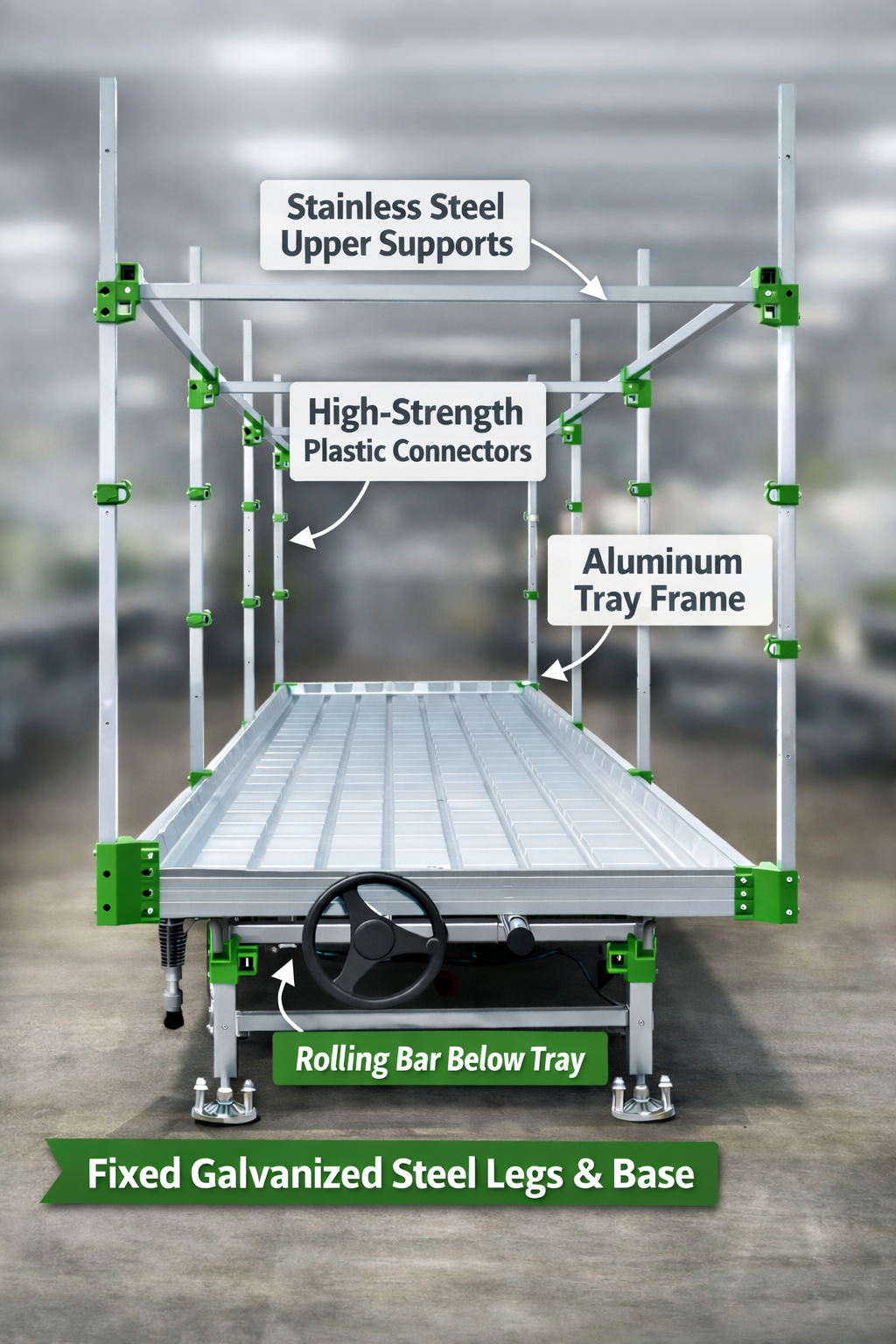
- Bar-driven, fixed-foot benches keep the feet anchored and slide the bed on a rolling bar under the tray. They avoid floor tracks, which some growers prefer for simple cleaning and straightforward retrofits in tight indoor rooms.
- V-track rolling benches move the entire structure on rails. They shine on long, straight runs where you want a guided path and a familiar greenhouse feel, and where you’re willing to get the floor and rail install right up front.
In practice, many operators end up using both: bar-driven benches inside dense indoor flower rooms and v-track benches in longer bays or hybrid greenhouse spaces. The common goal is the same—more canopy and better access from the same footprint.
Planning a V-Track Rolling Bench Layout
Planning starts with the room you actually have: column grid, drain positions, manifold locations, and the cleanest routes for staff and carts. Once those are set, you can drop in rail lines, bench lengths, and the maximum travel for each run.
At the same time, it makes sense to sketch the lighting grid and control zones. A neat v-track grid under a matched LED layout helps avoid wasted photons in aisles. When LEDs hit the right micromole numbers at lower wattage, you may qualify for rebates or incentives; a simple grow-light rebate guide is a good checkpoint before you lock in hardware and send a PO.
Where a V-Track Rolling Bench Makes Sense
V-track is worth a serious look when:
- You’re running long, straight bays where tracking and alignment matter more than anything else.
- The slab is in decent shape or you’re already planning to pour curbs or correct surfaces for other reasons.
- Owners or investors are coming from a greenhouse background and want something they recognize and trust.
- You like the idea of benches, lighting, and sometimes even crop trolleys all following the same rail logic.
In smaller, highly serviced rooms full of floor drains, conduits, and sensor stubs, a track-free, bar-driven bench is often easier to install and live with. The goal isn’t to crown a single winner; it’s to match the mechanism to the space.
Final Thoughts
A v-track rolling bench system trades some installation work—rails, anchors, careful layout—for clean, guided motion and a bench that behaves the same way every time you open an aisle. When the slab is good and the room is long, that trade can be well worth it.
If you’re comparing v-track to bar-driven rolling benches, it helps to walk the room on paper: where people enter, where water and power come from, how carts move, and where the lights will actually hang. Once that picture is clear, you can decide whether rails, fixed-foot benches, or a mix of both will make your grow easier to run over the next few cycles instead of just the next few weeks.
For hardware examples and layout ideas on both v-track and bar-driven designs, you can start with the bench options at GrowRollingBench.com and then tune the details around your own building.