
7 Proven Grow Room Yield Optimization Wins
Many commercial growers eventually hit the same wall: the building is full, every room is running, and there is no easy way to add more lights or plants without major construction. In a business where square footage is expensive and permitting is slow, the smartest move is often to focus on grow room yield optimization using the space you already have. That is where a well-designed rolling bench system becomes one of the highest-ROI upgrades in the facility.
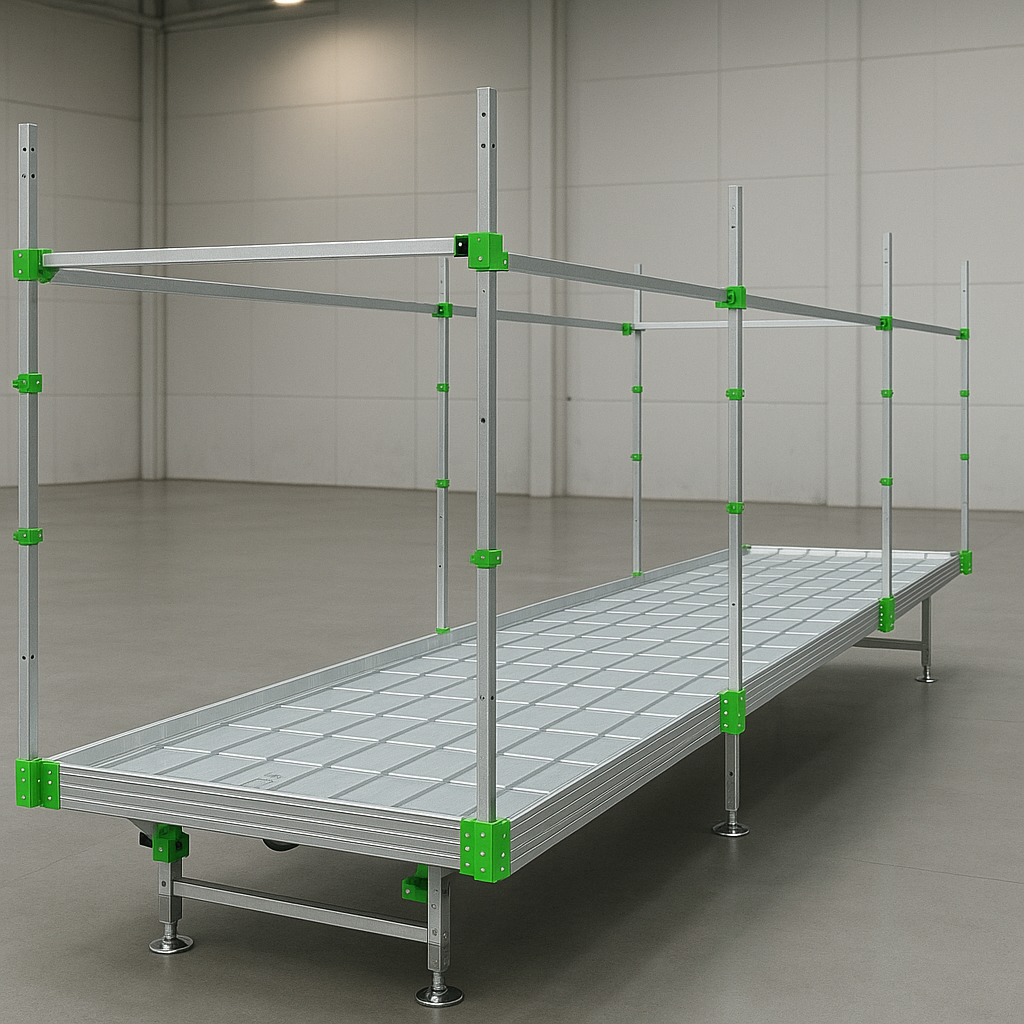
Instead of filling a room with fixed tables and permanent aisles, rolling benches slide side to side on tracks, allowing you to keep one movable access aisle and turn the rest of the floor into productive canopy. The result is higher plant counts, better workflow, and a more efficient relationship between your benches, lighting, and irrigation.
Grow Room Yield Optimization: From Walkways to Canopy
Traditional grow room layouts reserve 20–30 percent of the floor for fixed walkways. Those aisles never produce a single gram. By contrast, a rolling bench system lets benches sit close together during normal operation and only opens an aisle where and when it is needed.
In a typical flower room, this can translate into one or two additional bench runs per room. With dense crops like cannabis, leafy greens, or herbs, the extra canopy area can significantly increase yearly harvest volume without adding a single square foot of building space.
Better Alignment With Lighting Layouts
Modern LED fixtures throw relatively even light across rectangular footprints. When your bench layout does not match those footprints, you end up wasting photons in aisles or struggling with uneven coverage at the edges of the room. Rolling benches make it easier to align benches and lights into clean, repeatable patterns.
You can design your top-light grid and bench widths together, then slide benches to maintain ideal spacing below each row of fixtures. Many growers also pair rolling benches with supplemental under canopy lighting to keep lower sites productive instead of stripping leaves aggressively. Better use of vertical and horizontal light translates directly into stronger yields.
Improved Workflow and Labor Efficiency
Yield is not only about how many plants you can fit in a room; it is also about how consistently those plants are cared for. Rolling bench systems support more efficient daily workflows by shortening walking distances and making it easier for staff to reach every part of the canopy.
Instead of navigating wide fixed aisles, workers open a single rolling aisle where they need to prune, scout, trellis, or harvest. This reduces back-tracking and lets teams spend more time on plant work and less time walking.
Designing Rooms Around Rolling Bench Systems
To get the full benefit of rolling benches, the layout needs to be planned deliberately. Start with accurate room dimensions, door locations, drainage positions, and locations for manifolds, electrical panels, and control hardware. From there, you can choose bench lengths and widths that maximize canopy while still preserving safe access and emergency egress.
Many commercial growers work with vendors that specialize in grow room infrastructure to model multiple layout options before placing any equipment. Resources like the Next Generation Rolling Bench overview can help you visualize how different bench lengths, center aisles, and perimeter spacing impact canopy density and workflow.
Pairing Rolling Benches With Lighting and Rebate Strategies
Rolling benches are most powerful when they are part of a holistic upgrade that also includes modern LED fixtures and optimized controls. If you are already redesigning a room around new benching, it is often the ideal time to update your lighting layout and dimming schedules.
In many utility territories, energy-efficient horticultural LEDs qualify for generous utility energy rebates. While benches themselves are rarely rebated, the combined project can have a faster payback period once incentives are factored in. Guides such as this utility rebate overview for grow lights explain how to document your project and avoid leaving money on the table.
Yield, Consistency, and Risk Management
The most profitable facilities are not the ones that hit a record harvest once; they are the ones that repeat strong numbers cycle after cycle. Rolling bench systems contribute to that consistency by standardizing bench dimensions, access paths, and plant spacing from room to room.
Standardization makes it easier to train new staff, document successful recipes, and copy proven layouts into future expansions. It also reduces the risk that a poorly designed room becomes a permanent bottleneck for watering, spraying, or harvesting. When every flower room follows the same rolling bench logic, you can compare performance apples-to-apples and refine your operating procedures over time.
When Rolling Bench Systems Make the Most Sense
Rolling benches provide the biggest benefit in rooms where space is tight, canopy is dense, and staff are in and out of the room every day. Facilities that run high-value crops like cannabis or premium leafy greens see especially strong returns because every square foot of recovered canopy converts directly into revenue.
There are a few scenarios where fixed benches or static tables may still be acceptable – for example, very small hobby rooms, low-density mother plant areas, or temporary research spaces. For serious commercial production, however, a rolling bench system is usually the smarter long-term play.
Final Thoughts
Increasing yield does not always require new buildings, more power, or more flowering rooms. In many cases, the fastest way to grow output is simply to use your existing space more intelligently. A well-designed rolling bench system helps you turn walkways into canopy, align benches with lighting, streamline labor, and support repeatable results.
If you are planning a new facility or considering an upgrade to an existing one, it is worth running the numbers on how much additional canopy a rolling bench layout could unlock. For many commercial growers, that calculation is what turns rolling benches from a “nice-to-have” into a cornerstone of the entire grow room design.